By the time most organizations notice a breach, the attacker has already been inside for days or weeks – quietly receiving instructions from a remote server. That quiet connection is the heart of a command and control (C2) attack, and it is the mechanism behind almost every serious intrusion, from data theft to ransomware.
At CyberSafe, we see C2 traffic for what it really is: the attacker’s lifeline. Cut it, and the intrusion stalls. Miss it, and a minor compromise escalates into a full-scale incident. Across our SIEM SOC and incident-response work, the organizations that contain attacks early are almost always the ones that could see the C2 channel – and the ones that suffer the most are those who only discovered it once the screens were already locked.
What Is a Command and Control (C2) Attack?
| A command and control (C2 or C&C) attack is a critical cyberattack tactic where malware establishes a covert communication channel to an attacker-controlled server. By leveraging protocols like HTTPS or DNS, attackers maintain persistent remote control to perform lateral movement, exfiltrate data, or deploy ransomware. |
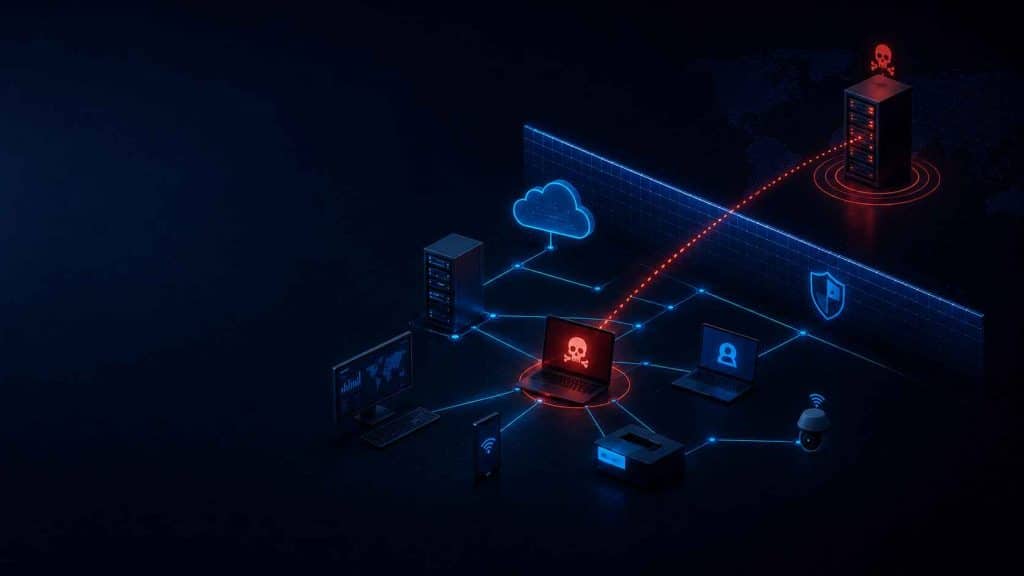
In a C2 attack, malware installed on a victim’s machine – a “beacon” or implant – reaches out to the attacker’s command-and-control server to ask for instructions. The compromised host is sometimes called a “zombie”; when many are linked together, they form a botnet under the attacker’s control.
The MITRE ATT&CK framework classifies C2 as a dedicated tactic (TA0011), spanning roughly 16 techniques and dozens of sub-techniques that describe how adversaries communicate with systems inside a target network. What makes C2 so dangerous is its timing: it appears late in the attack chain, after other defenses have already been bypassed. By the time a C2 channel is active, the attacker is already inside.
How Does a Command and Control Attack Work?
| A C2 attack typically unfolds in five stages: initial compromise (e.g., phishing or an exploited vulnerability), malware installation, establishing the C2 channel (the malware “phones home”), command execution (the attacker issues instructions), and persistence (maintaining access over time). The channel is usually hidden inside ordinary traffic to avoid detection. |
While techniques vary, almost every C2 attack moves through the same sequence:
- Initial compromise. The attacker gains a foothold – commonly through a phishing email, a malicious attachment, a drive-by download, or by exploiting a known software vulnerability.
- Malware installation. A backdoor or implant is dropped onto the system, designed to communicate with the attacker’s infrastructure.
- Establishing the C2 channel. The implant “phones home” to the C2 server, often via periodic beaconing – small, regular signals asking for instructions – to signal it is ready.
- Command execution. The attacker issues commands: download more malware, harvest credentials, map the network, move laterally, or begin exfiltrating data.
- The attacker entrenches access – through redundant channels and stealth – so control survives reboots, password changes, and partial cleanup.
The critical detail is stealth. C2 traffic is deliberately blended into legitimate protocols – HTTP/HTTPS, DNS, even ICMP – and frequently encrypted, so it looks like ordinary web or name-resolution traffic. This is exactly why C2 so often goes unnoticed without dedicated monitoring.
| Field Example – Beaconing hidden in plain sight
During a monitoring engagement for a mid-sized SaaS company, our SOC team flagged a workstation making small outbound HTTPS connections to the same external destination at almost-regular intervals – roughly every minute, with slight random jitter. Nothing about a single connection looked malicious; it was port 443, encrypted, to a domain that resolved normally. But the pattern was the giveaway: legitimate applications do not beacon with machine-like regularity. The destination turned out to be a recently registered domain with no history. We isolated the host, confirmed an implant, and cut the channel before the attacker progressed beyond reconnaissance. The customer’s existing tools had logged every one of those connections – no one had been correlating them. |
What Are the Main C2 Architectures?
| Attackers structure C2 infrastructure in three main ways: centralized (all implants talk to one server – simple but easier to take down), peer-to-peer (compromised hosts relay commands among themselves – resilient and harder to disrupt), and a hybrid model that combines both for redundancy. Sophisticated actors design for stealth and resilience. |
Understanding how C2 infrastructure is organized helps explain why some attacks are so hard to disrupt:
| Architecture | How it works | Why it matters |
| Centralized | All compromised hosts communicate with a single C2 server | Easiest for attackers to run – but also easiest to detect and take down once the server is identified |
| Peer-to-peer (P2P) | Infected hosts relay commands among themselves, with no single hub | Highly resilient; removing one node doesn’t break the network. Often used as a fallback |
| Hybrid | Combines centralized control with P2P fallback | Designed for resilience – if the main server is taken down, control persists through peers |
Modern attackers reinforce these architectures with evasion techniques: domain fronting (routing traffic through trusted cloud/CDN services so it appears to terminate at reputable providers), DNS tunneling (encoding data inside DNS queries, which are rarely blocked), and domain generation algorithms that constantly rotate the domains an implant calls home to.
How Do Attackers Hide C2 Traffic?
| Attackers hide C2 traffic by blending it into protocols that are almost never blocked. The most common methods are HTTP/HTTPS beaconing (traffic that looks like normal web browsing), DNS tunneling (data encoded inside DNS queries and responses), and encrypted custom channels. Because the traffic looks legitimate, detection depends on behavioral analysis rather than signatures. |
- HTTP/HTTPS beaconing – the most common transport, because it blends seamlessly with everyday web traffic. The implant checks in on a schedule, often with random “jitter” to disguise the rhythm.
- DNS tunneling – small amounts of data encoded into DNS subdomain labels and responses. Since DNS is rarely blocked, it offers a reliable covert channel; tell-tale signs include unusually long subdomains and high query volume to a single domain.
- Encrypted and custom protocols – traffic that cannot be inspected at the payload level, forcing defenders to rely on metadata and behavior.
- Cloud and trusted-service abuse – using legitimate platforms as relays so traffic terminates at reputable, allow-listed destinations.
The common thread is that signature-based tools alone are not enough. Because C2 increasingly relies on legitimate software, stolen credentials, and encryption, modern detection depends on behavioral analytics – spotting the pattern of the conversation, not just its contents.
Why Are C2 Attacks So Dangerous to Organizations?
| Because a C2 channel is not the end of an attack – it is the enabler of everything that follows: lateral movement, credential theft, data exfiltration, and ransomware deployment. C2 gives an attacker persistent, hands-on control inside the network, which is why detecting it early is one of the highest-value outcomes a security operation can deliver. |
A C2 attack is rarely the objective in itself; it is the foundation for the real damage. Once the channel is live, the attacker can operate inside the network almost as if they were a legitimate administrator – escalating privileges, moving laterally between systems, and quietly staging data for theft.
This is also why C2 is so tightly linked to ransomware. In most modern ransomware operations, the encryption everyone fears is the final step. Long before any screen is locked, the attacker used a C2 channel to map the environment, disable backups, and exfiltrate sensitive data for double-extortion. The organizations that detect the C2 stage stop the attack while it is still recoverable; those that don’t, discover it only when the ransom note appears. A C2 attack is therefore not an “IT event” – it is a business event, with operational, financial, and regulatory consequences that outlast the technical cleanup.
How Do You Detect and Prevent C2 Attacks?
| Effective C2 defense layers prevention and detection: control outbound traffic (proxies, DNS monitoring, network segmentation) to limit where implants can call home, and deploy behavioral detection – typically through a SIEM and SOC – to catch beaconing patterns, anomalous DNS, and unusual connections that signature tools miss. Because C2 hides in legitimate traffic, continuous monitoring is the decisive control. |
No single tool stops C2. The strongest defense combines prevention (making it harder for an implant to communicate) with detection (catching the channel when prevention is bypassed).
Prevention: limit where implants can call home
- Route outbound web traffic through an authenticated proxy with TLS inspection, and force DNS through monitored corporate resolvers.
- Segment the network so not every system can reach the internet directly – this alone breaks many default implant configurations.
- Restrict remote-access and administration tools to an approved list, and keep systems patched to close the vulnerabilities used for initial compromise.
Detection: see the conversation, not just the connection
This is where a SIEM and a SOC become decisive. A SIEM centralizes logs from firewalls, proxies, DNS, and endpoints, and a SOC analyzes them continuously for the behavioral signatures of C2: periodic beaconing to a single destination, newly registered or low-reputation domains, abnormally long DNS subdomains, high query volume to one domain, and connections that correlate with suspicious process activity. None of these is obvious in isolation – the value is in correlating them in real time, which is exactly what continuous monitoring is built to do.
At CyberSafe, our SIEM/SOC services are designed around precisely this problem – turning the flood of routine network logs into early, high-fidelity signals that a C2 channel exists, so it can be cut before exfiltration or encryption. The field example above is the rule, not the exception: the evidence is almost always in the logs already; the difference is whether anyone is correlating it.
| Field Example – Validating defenses before an attacker does
A fintech client was confident their firewall and endpoint tools would catch C2 activity. As part of a penetration testing engagement, our team safely emulated several C2 techniques – an HTTPS beacon, a DNS-tunneling channel, and an encrypted custom protocol – to test what their controls actually detected. Two of the three slipped through silently: the firewall logged the traffic but raised no alert. The exercise didn’t just find the gap; it gave the client a prioritized, evidence-based case for tuning their detection rules and tightening outbound DNS – closing the holes before a real adversary found them. |
Where Does C2 Defense Fit in a Mature Security Program?
C2 detection is not a standalone product you buy – it is an outcome of a well-run security operation. It depends on continuous monitoring, skilled analysts, validated controls, and clear ownership of who acts when an alert fires. In our experience, the organizations that handle C2 well treat it as one layer in a connected program:
- Continuous SIEM/SOC monitoring to detect the behavioral signs of an active channel in real time.
- Penetration testing and attack simulation to validate that those detections actually fire against realistic C2 techniques – not just in theory.
- A defined response process so that detection leads to containment in minutes, not days.
Tying these together is a governance question as much as a technical one. Many growing organizations gain this coordination through a CISO-as-a-Service model – senior security leadership that connects monitoring, testing, and response into a coherent strategy, and aligns it with frameworks the business already needs to satisfy. A recognized information security management standard such as ISO 27001 provides the structure for that program, while SOC 2 Complience demonstrates to customers that the monitoring and response controls operate consistently over time. Increasingly, as defenders and attackers alike adopt AI-driven tooling, standards like ISO 42001 for AI management systems are extending this same governance discipline to AI-enabled detection itself.
The takeaway is simple: a C2 channel is the moment an intrusion becomes an active, hands-on attack. Seeing it early is one of the highest-value things a security program can do – and it is almost entirely a function of whether someone is watching the right signals. Working with an experienced information security company that combines monitoring, testing, and response is how most organizations close that gap.
| Not sure whether you’d see a C2 channel in your environment today? Talk to our SOC team about monitoring and attack-simulation that surface the signals attackers count on you to miss. |
Frequently Asked Questions
What is the difference between C2, C&C, and a botnet?
“C2” and “C&C” are interchangeable abbreviations for command and control – the channel an attacker uses to control compromised systems. A botnet is the result when many compromised machines are linked under a single C2 infrastructure and controlled together, often to launch coordinated attacks such as DDoS.
Why is C2 so hard to detect?
Because attackers deliberately disguise C2 traffic inside protocols that are almost never blocked – HTTPS, DNS – and frequently encrypt it. Each connection looks legitimate in isolation. Detection therefore relies on behavioral analysis (beaconing patterns, anomalous DNS, low-reputation domains) rather than simple signature matching.
Is C2 related to ransomware?
Yes – directly. Most modern ransomware uses a C2 channel to operate inside the network before encryption: mapping systems, stealing credentials, disabling backups, and exfiltrating data. Detecting the C2 stage is often the last opportunity to stop a ransomware attack while it is still recoverable.
Can a firewall alone stop C2 attacks?
Not reliably. A firewall can block some outbound connections, but C2 that hides in HTTPS or DNS frequently passes through. Effective defense pairs outbound controls with continuous SIEM/SOC monitoring that detects the behavioral signs of an active channel.